A recruitment website for the study, without the vendor microsite
Study Landing Pages and Pre-Screeners
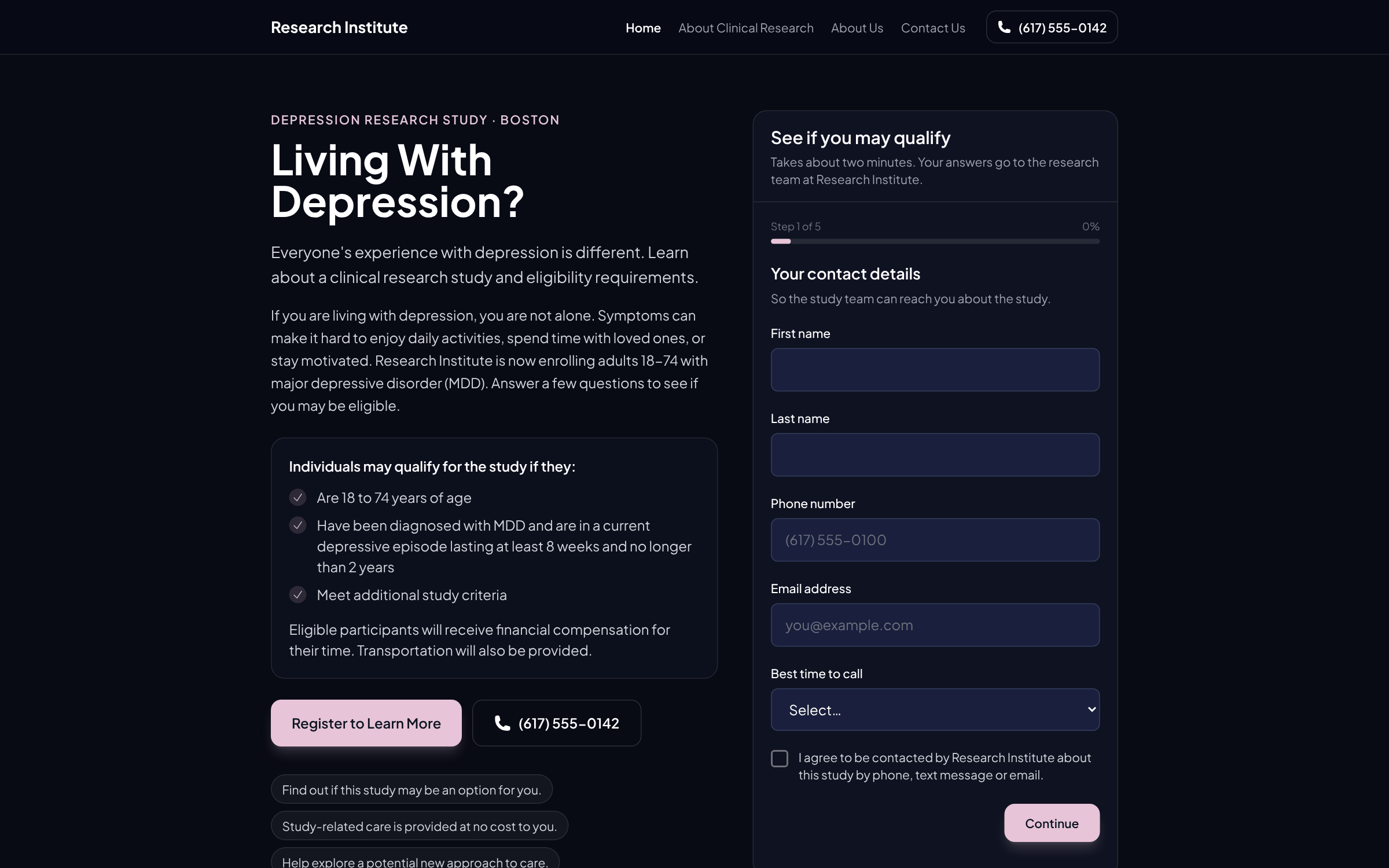
Trialflow builds and hosts message-matched landing pages and a multi-step pre-screener for your study, written from your IRB-approved copy and wired straight into your pipeline.
What you get
- A landing page per ad angle, so the page says what the ad said
- A multi-step pre-screener evaluated against the study’s inclusion and exclusion criteria
- Submissions create or update the lead, log every answer, and notify site staff
- Copy traced line by line to the IRB document it comes from, with an exportable IRB packet
- Built-in analytics: sessions, step-by-step drop-off, taps on the phone number, device, and channel
- Visits attributed to the right channel by tracking code, UTM, or ad click ID
- Previews of every search, display, and social ad unit built from the approved copy
Why it matters
An ad is only as good as the page it lands on. For each study, Trialflow sets up a study hub: a landing page for every ad angle, the supporting pages your sitelinks point at, and a multi-step pre-screener that asks for contact details first and the inclusion and exclusion questions a few at a time. Every line on the pages is traced to the IRB document it comes from, every submission becomes a scored lead in your database, and every visit is measured — so you can see which page, which channel, and which question people drop off at.
See it in action
Study Landing Pages and Pre-Screeners, inside Trialflow
FAQ
Study Landing Pages and Pre-Screeners questions, answered
Do we need our own website or a recruitment vendor’s microsite?+
No. The study hub is the recruitment website: landing pages, an About Clinical Research page, About Us, Contact, and the pre-screener, branded with your site’s name, address, and phone number. If you already have a vendor-built site, campaigns can point there instead with tracked links.
Who writes the pages?+
Trialflow builds them from your IRB-approved website copy and ad content. Each line is annotated with the document it comes from, and a packet of every page and question exactly as rendered can be exported for your IRB submission.
How does the pre-screener work?+
It collects contact details first, then walks through the study’s inclusion and exclusion questions a few at a time. Answers are evaluated on the server, the lead is created or updated and linked to the study, every answer is logged on the lead’s record, and your notifications, workflows, and matching fire as they would for any other lead.
Why more than one landing page?+
People respond to different messages. Each ad angle gets its own page with a matching headline and layout, and the report shows sessions, pre-screener starts, and submissions per page — so you can see which message converts rather than guessing.
What do you track about visitors?+
Page views, pre-screener starts, how far each visitor got, submissions, taps on the phone number, and device type — tied to an anonymous per-visit id. No contact details, answers, IP address, or user agent are stored with that activity.
Are conversions reported back to the ad platforms?+
Yes. Accepted pre-screener submissions can be reported to Google Ads and the Meta Pixel as conversions, so the platforms optimize toward people who complete the pre-screener rather than people who click.
How do the landing pages connect to campaign reporting?+
Each channel’s tracking link carries its code and UTM values into the page and through to the submission. Visits that arrive without a code are attributed by UTM source or by the Google or Meta click ID, so ads built directly in the ad platforms still report against the right channel.
See Study Landing Pages and Pre-Screeners in action
Get a personalized walkthrough tailored to your studies and therapeutic areas.